
TL;DR - Quick Summary
Transitioning from the toddler years to middle childhood (ages 4-12) is a pivotal phase for Indian families. This comprehensive guide explores age-specific strategies, balancing academic rigor with emotional growth, and navigating modern challenges like screen time. By focusing on "sanskars," curiosity, and open communication while implementing effective parenting tips for kids, parents can raise resilient, well-rounded individuals who are prepared for the future.


Introduction: The Golden Age of Middle Childhood
The transition from a toddler to a school-age child is one of the most significant shifts in the Indian parenting journey. As children enter the "middle childhood" phase (ages 4 to 12), they begin to develop their own identities, friendships, and academic interests. This era is often called the "Golden Age" because it is a window of immense cognitive flexibility and emotional molding. For many Indian parents, this is the time when the foundation for a successful future—not just professionally, but personally—is laid.
Implementing effective parenting tips for kids during this window is crucial because these years are less about basic survival like eating and sleeping, and more about character building and cognitive development. In the Indian context, where family values and academic excellence often take center stage, finding a balance between traditional "sanskars" and modern progressive values is essential. We are no longer just keeping them safe; we are helping them decode the world and develop into confident, capable individuals.
Preparing kids for the future isn't just about high grades; it's about nurturing emotional intelligence, critical thinking, and a sense of belonging within the community. In a rapidly changing global landscape, the ability to adapt while staying rooted in one's culture is a superpower that every child needs. At MissPoppins.in, we believe that informed parents create empowered children who are ready to take on the world with confidence and grace.
The parenting challenges in india are unique and multifaceted. From managing competitive academic environments to preserving cultural values while embracing technological advancement, Indian parents navigate a complex landscape. This guide provides practical indian parenting advice that honors our traditions while equipping children with skills for tomorrow's world.
Age-Wise Parenting Strategies
Every stage of childhood requires a different approach. What works for a 4-year-old will likely backfire with a 10-year-old because their cognitive architecture and social needs shift dramatically every few years. Here is some tailored indian parenting advice to help you navigate these shifting gears with patience and insight, addressing the specific parenting challenges in india at each developmental stage.
Preschool Years (4-6): The Foundation of Discovery
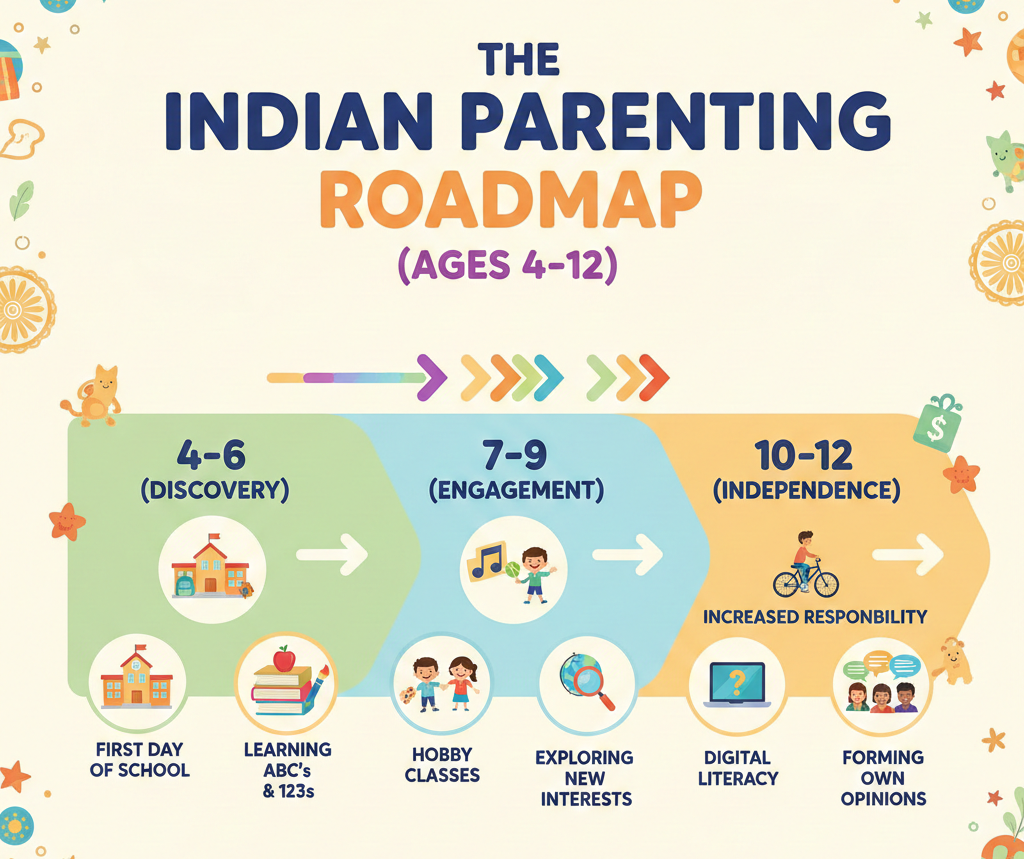
At this age, children are literal sponges, soaking up every word, gesture, and habit they observe at home. This is the stage of "The Great Discovery," where the world expands beyond the nursery. Parenting tips for kids in this age group should focus on routine and play-based learning. In India, many kids start formal schooling around age 4, which can be an overwhelming transition that requires careful parental support.
It's important to focus on building independence through small, manageable victories. Let them choose between two shirts, pack their own water bottle, or help set the table for dinner. These seemingly minor tasks build confidence and self-reliance. The playground becomes the first laboratory for social science—encourage playdates to help them navigate sharing, waiting for their turn, and the inevitable minor conflicts that arise in group settings.
India's linguistic diversity is an incredible asset. Read stories in both English and your mother tongue to build a robust bilingual foundation, which research has shown improves cognitive flexibility later in life. This early exposure to multiple languages is one of the unique advantages available to Indian children, and these parenting tips for indian parents emphasize maximizing this developmental opportunity.
Early School Years (7-9): Building Competence and Effort
The primary school years are defined by a search for "competence." Children start comparing themselves to peers, noticing who runs fastest or who reads best. Parenting tips for indian parents at this stage should emphasize effort over results. This is the "Process over Product" phase. They are now dealing with more complex homework and intricate social hierarchies that require understanding and guidance.
This is the perfect time to introduce basic responsibilities around the house, like clearing their plate, organizing their bookshelf, or even helping with basic kitchen prep under supervision. These tasks instill a sense of contribution and belonging. When children feel they are valuable contributors to the household, their self-esteem grows naturally, and they develop important life skills that will serve them throughout their lives.
Pre-teen Years (10-12): Coaching Through Transition
Welcome to the bridge between childhood and adolescence. This is often where parenting challenges in india become more apparent as children seek more autonomy and begin to value peer opinions more than parental ones. Parenting tips for kids aged 10-12 should focus on "coaching" rather than "controlling." Instead of dictates, use dialogue. They need to feel heard and respected as their personality crystallizes.
Discussing physical changes, the nuances of online safety, and the pressures of fitting in becomes a vital daily conversation rather than a one-time "talk." These years require parents to shift their approach from directive management to collaborative guidance, helping pre-teens develop their own decision-making skills while still providing a safety net of support and wisdom.

Academic Success Without Pressure
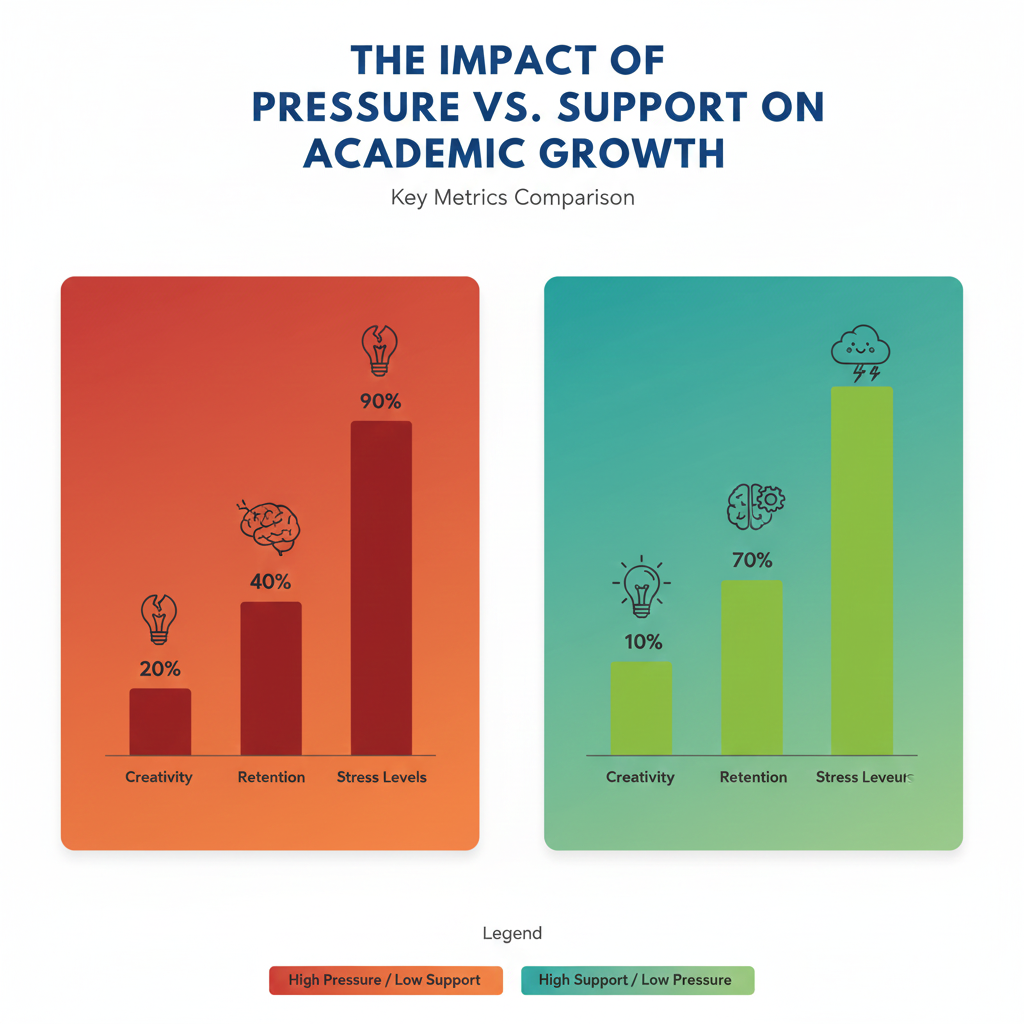
The Indian education system is notoriously competitive, often placing immense weight on standardized testing. As parents, it is easy to fall into the trap of "Comparison Culture," looking at the neighbor's child's report card. However, research shows that high-pressure environments often lead to chronic anxiety and burnout rather than genuine brilliance. Implementing balanced parenting tips for kids helps create an environment where learning thrives without overwhelming stress.
Homework Help Strategies
Instead of doing the work for them or hovering over their shoulder, create a "Success Station"—a quiet, well-lit area dedicated to study, free from the distractions of the TV or kitchen noise. Parenting tips for kids regarding homework include teaching them the "pomodoro" technique: breaking large projects into smaller, 25-minute manageable tasks followed by short "active breaks" like stretching or a quick snack. This builds focus and prevents the dread associated with long study hours.
Dealing with the Indian Education System
We know the system often prioritizes rote learning and memorization, but you can supplement this at home by fostering a "Questioning Culture." Encourage your child to ask "Why does this work?" and "How is this used in real life?" rather than just "What is the definition?" Use MissPoppins.in resources to find creative ways to make standard curriculum topics, like history or math, come alive through storytelling and games.
Tuition Classes: Yes or No?
This is a classic dilemma in every Indian household. While coaching centers are a staple in our society, they should be a tool, not a crutch. If a child is genuinely struggling with a concept, a tutor might provide the necessary bridge; however, if they are already excelling, piling on extra classes might lead to mental exhaustion. Always prioritize a child's mental health and their "right to play" over an extra 5% on a report card. A burnt-out child cannot learn effectively.
Encouraging Curiosity and Learning
The best learning often happens outside the classroom. Visit local museums, conduct simple science experiments in the kitchen, or watch historical documentaries together. When you model curiosity by looking up things you don't know, your child follows your lead. Parenting tips for indian parents often overlook the power of "learning for fun" because we are so focused on "learning for exams." Shift the focus to the joy of discovery.
Building Character and Values
In India, we call it "Sanskar"—the internal moral compass that guides a child throughout their life. In a world of shifting sands, building character is perhaps the most important indian parenting advice we can offer. These values become the foundation upon which children build their entire lives, influencing every decision they make.
Teaching Honesty and Integrity
Children don't lie because they are "bad"; they lie when they are afraid of the consequences of the truth. To foster honesty, create a "Truth Safe Zone" where they can admit mistakes—like a broken vase or a failed test—without the fear of immediate, harsh punishment. Focus on solving the problem together, which fosters a lifelong habit of integrity and accountability. This approach aligns with effective parenting tips for kids that build trust and open communication.
Respect and Sanskar
Respecting elders and the community is a cornerstone of Indian culture. However, it is vital to teach your children that respect is a two-way street based on dignity, not just age. When you respect your child's boundaries, listen to their opinions, and apologize when you are wrong, they learn to respect others authentically and deeply, not just out of social obligation. This balanced approach addresses modern parenting challenges in india where traditional values meet contemporary understanding.
Empathy and Kindness
Empathy is like a muscle; it needs regular exercise. Incorporate "Acts of Kindness" into your weekly family routine. Whether it's feeding a stray dog, helping a neighbor with groceries, or sorting through old toys to donate to an orphanage, these actions make the abstract concept of empathy tangible. Parenting tips for kids should always prioritize the development of emotional intelligence as much as IQ.
Religious and Spiritual Education
Whether your household is deeply religious or secular, teaching your child about Indian heritage, the stories behind our festivals, and the underlying philosophies provides a sense of identity and grounding. Explain the meaning and history behind rituals—why we light lamps or celebrate harvests—rather than just asking them to follow along blindly. Understanding one's roots provides the wings to fly and creates a strong sense of cultural identity.
Technology and Screen Time
The digital divide in India is shrinking rapidly, and kids are more online than ever. While the internet is a vast library, it is also a wild frontier, presenting significant parenting challenges in india. Effective parenting tips for indian parents must include strategies for managing technology wisely.
Age-Appropriate Limits
Establishing boundaries early is easier than trying to take away a device later. For ages 4-6, limit screen time to 1 hour of high-quality educational content, ideally co-viewed with a parent to explain what's happening. For ages 7-9, allow 1.5 hours, permitting some recreational gaming or creative digital hobbies like drawing. For ages 10-12, up to 2 hours is acceptable, but with strictly enforced "No-Phone" zones, such as the dinner table or the bedroom after 9 PM.
Educational Apps and Content
Not all screen time is detrimental. Encourage apps that focus on coding, language learning, or logical puzzles. These turn the screen from a passive entertainment device into an active tool for creation. At MissPoppins.in, we curate lists of child-safe digital resources that are culturally relevant and educationally sound.
Online Safety for Kids
Digital literacy is the new life skill. Teach your child the "Golden Rule of the Internet": Never share your name, school, address, or photos with strangers. Use parental controls, but rely more on building a relationship of trust. If they see something "weird" or "scary" online, they should feel comfortable showing it to you without fear of losing their device. This trust is the most essential of all parenting tips for kids in the 21st century.
Extracurricular Activities
In the rush for academic excellence, hobbies are often the first thing to be cut from a child's schedule. However, extracurriculars are not "extra"; they are vital for brain development, stress relief, and social growth. This understanding is crucial indian parenting advice in today's competitive environment.
Balancing Academics and Hobbies
A child's schedule shouldn't look like a corporate executive's calendar. Ensure there is "white space" or "free play" in their day for doing absolutely nothing. This is when the brain processes information and when true creativity is born. Parenting tips for indian parents should include the liberating phrase: "Boredom is often the mother of invention."
Finding Your Child's Passion
It is a common mistake to project our own unfulfilled dreams onto our children. If you always wanted to be a state-level cricketer but your child is fascinated by the flute or coding, support their path. Trial and error is a natural part of childhood. Let them try different classes—from karate to pottery—until they find the one that truly makes their eyes light up. Their passion should be theirs, not yours.
Communication and Quality Time
You could follow every parenting tips for kids in the world, but without a strong emotional connection, your advice will fall on deaf ears. Connection is the conduit through which all parenting flows. Building this connection requires intentional effort and consistent presence.
The 15-Minute Rule: Commit to spending at least 15 minutes of "uninterrupted" time with your child daily. This means no phones, no work talk, and no chores—just you and them, following their lead in play or conversation. This simple practice addresses many parenting challenges in india where busy schedules often crowd out quality family time.
Active Listening: When your child speaks, put your phone down and give them your full attention. Validate their feelings ("I can see that made you sad") before jumping in with a solution. Often, they just want to be heard, not fixed.
Family Rituals: Rituals create the "scent" of a home. Whether it's a specific Sunday morning breakfast, a Friday movie night with popcorn, or a nightly prayer, these repetitive, positive interactions create a deep sense of security and belonging that children carry with them throughout their lives.
Health and Nutrition
A healthy mind resides in a healthy body, and the habits formed between ages 4 and 12 often persist into adulthood. With the rise of fast food in urban India, maintaining a balanced diet is a constant effort that requires thoughtful parenting tips for kids.
Traditional Diet: Lean into the wisdom of the Indian kitchen. Home-cooked meals like Dal, Chawal, and seasonal Sabzis are nutritionally dense and balanced. Avoid the "Kid's Menu" trap of processed nuggets and fries by involving them in the cooking process. When children help prepare meals, they develop a healthier relationship with food.
Physical Activity: Urban Indian cities often lack open green spaces, but physical activity is non-negotiable. Encourage indoor yoga, family dance sessions, or weekend trips to sports complexes for swimming or badminton. Regular physical activity is essential indian parenting advice for both physical and mental health.
Sleep Hygiene: A growing brain is a hungry brain—hungry for rest. School-age kids need 9–11 hours of quality sleep to process what they've learned. A consistent, calming bedtime routine is the best gift you can give their developing cognitive functions.
Quick Reference Guide: Age-Wise Parenting Focus
| Age Group | Primary Focus | Key Parenting Tips for Kids |
|---|---|---|
| 4-6 Years | Routine & Discovery | Focus on fostering independence and foundational social skills through play. |
| 7-9 Years | Competence & Effort | Praise the process over the result, introduce chores, and support varied hobbies. |
| 10-12 Years | Autonomy & Coaching | Prioritize open dialogue, build digital trust, and prepare them for adolescence. |
Conclusion: The Journey of Growth
Raising a child in today's fast-paced world is undoubtedly complex, but it is also one of the most deeply rewarding journeys a human can undertake. By applying these parenting tips for kids, you aren't just managing their daily behavior; you are architecting a relationship of trust and respect that will last a lifetime. Remember, there is no such thing as a "perfect" parent. There are only parents who show up, try their best, learn from their mistakes, and keep growing alongside their children.
arenting tips for indian parents often emphasize the future and the "destination," but don't forget to enjoy the present journey. These years from 4 to 12 fly by in what feels like a heartbeat. The moments you create today—the bedtime stories, the weekend adventures, the family dinners—become the memories your children will cherish forever and the foundation upon which they build their own families someday.
The parenting challenges in india are real and varied, from academic pressures to maintaining cultural identity in a globalized world. However, with the right indian parenting advice and a commitment to growing alongside your children, these challenges become opportunities for connection, learning, and mutual growth.
For more tailored support, community discussions, and expert advice, visit MissPoppins.in and join our community of conscious, dedicated parents who are committed to raising the next generation with love, wisdom, and cultural awareness.

Social Skills Development
As children enter school, their "tribe" expands from the family unit to a peer group. This transition brings a new set of social complexities that require careful guidance. Parenting tips for indian parents must address these dynamics as children learn to navigate the modern Indian playground, where traditional values meet contemporary social structures.
Making and Keeping Friends
Help your child identify the qualities that make a "good friend." Discuss values like loyalty, kindness, and shared interests. If your child is naturally shy, role-play social scenarios at home, helping them learn how to initiate a conversation with a simple "Can I play too?" or "I like your drawing." Teaching them how to be a good friend is the first step in helping them find good friends.
Handling Peer Pressure
Peer pressure can start surprisingly early in India, often manifesting in "brand consciousness" or pressure to excel in certain ways. Empower your child by building their internal self-esteem. When a child feels secure in their own skin and valued for who they are at home, they feel less of a desperate need to conform to the group's external demands. Teach them that it's okay to stand out. These parenting tips for kids help build resilience against negative social influences.
Anti-Bullying Strategies
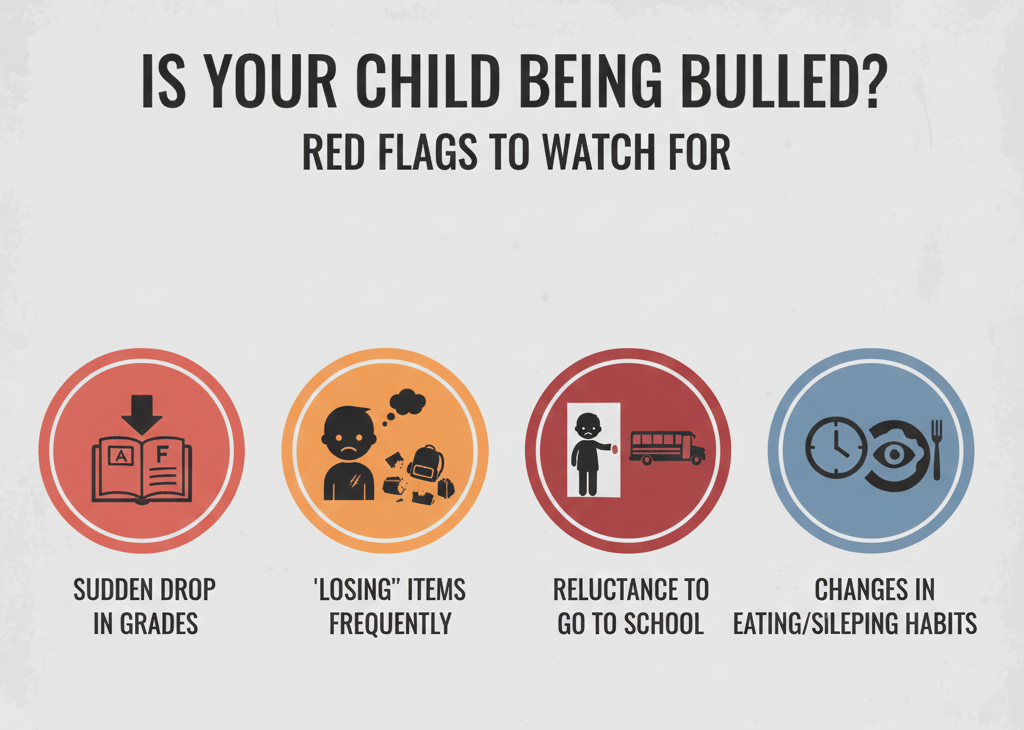
Bullying is one of the major parenting challenges in india that often goes under-reported due to the "tough it out" mentality. Teach your child the crucial difference between "tattling" (trying to get someone in trouble) and "reporting" (trying to keep someone safe). Ensure they know that your home is a sanctuary where they can always come to you if someone is making them feel unsafe, small, or excluded.